
AI Agents
How AI Agents Are Changing Software Development in 2026: From Coding Assistants to Agentic Engineering
AI is moving from autocomplete to work across planning, implementation, testing, and review. Here is what agentic software development changes for engineering teams.
Arslan Chaudhary, Technical Team Lead, BXTrack
March 12, 2026·10 min read
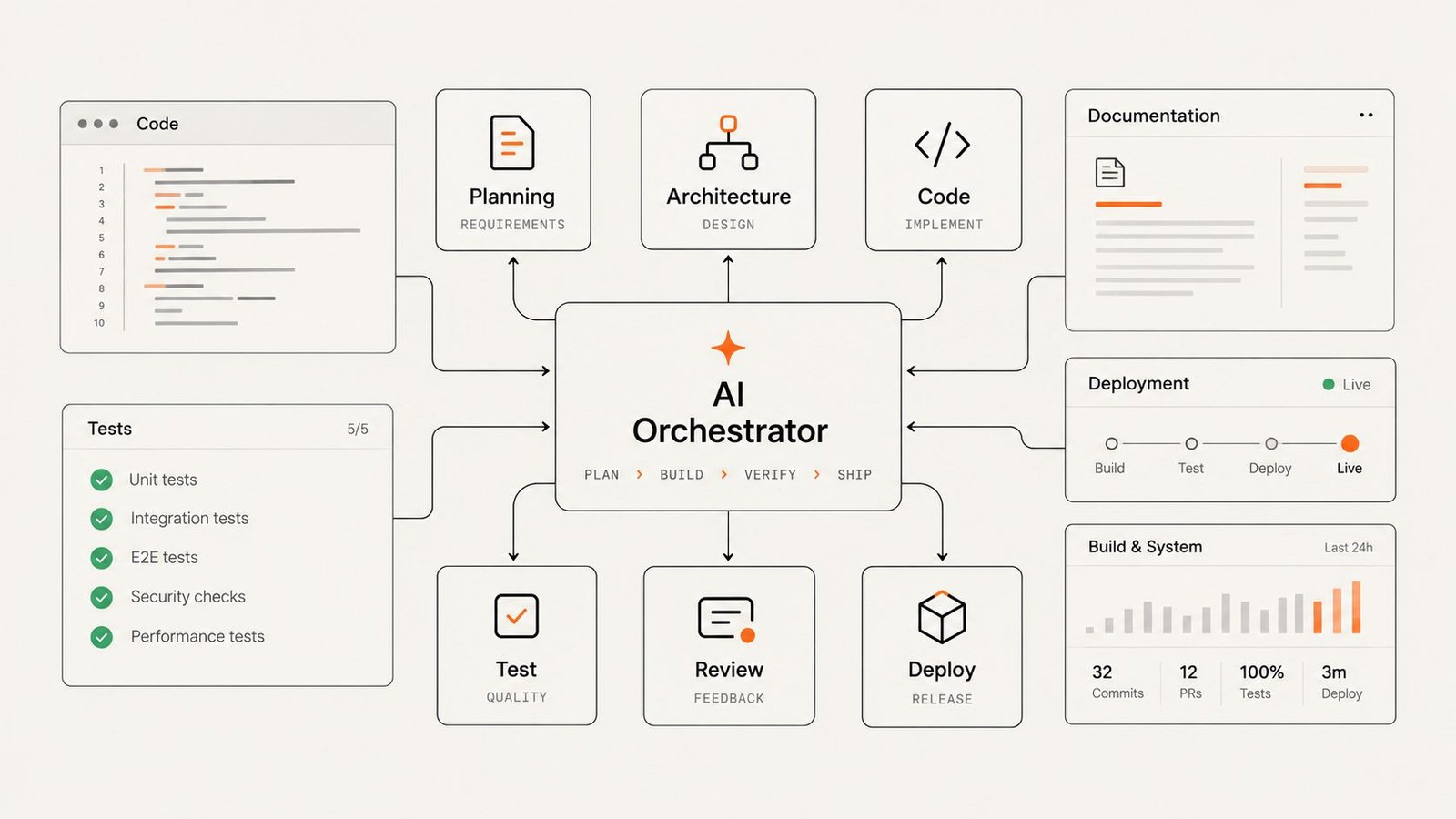
Software development is going through one of its biggest shifts since cloud computing. For the last few years, artificial intelligence mainly acted as an assistant. Developers used AI to autocomplete code, explain errors, generate functions, write documentation or suggest fixes.
In 2026, that model is changing. AI is moving from assisting developers with individual tasks to actively participating across the software development lifecycle.
Modern AI coding agents can inspect an existing codebase, understand requirements, create implementation plans, modify multiple files, run tests, debug failures and iterate on their own work.
This shift is giving rise to what is increasingly called agentic software development. For businesses building digital products, the impact goes far beyond writing code faster: it changes how software is planned, designed, developed, tested and maintained.
From AI Coding Assistants to AI Coding Agents
The first generation of AI development tools primarily helped developers write code faster. A developer remained responsible for understanding the problem, deciding what needed to change, implementing it, testing it and debugging the result.
AI coding agents operate differently. Instead of asking for an isolated function, a developer can provide a higher-level objective such as: “Add role-based access control to this application. Review the current authentication architecture, propose an implementation, update the API and frontend, add tests and verify that existing functionality still works.”
The agent can break that objective into tasks and work through them. This is the practical difference between AI-assisted development and agentic development.
AI Coding Agents Are Becoming Mainstream
JetBrains’ 2026 Developer Ecosystem research, based on more than 15,000 professional developers, reported that 90% were using AI coding agents at work at least weekly during May-July 2026, while 68% were using them daily. See JetBrains Research.
Gartner describes enterprise AI coding agents as a shift from AI-assisted development toward agentic software development spanning planning, code creation and review. See Gartner Critical Capabilities for Enterprise AI Coding Agents.
McKinsey’s 2026 analysis makes the broader point that meaningful gains require redesigning the product-development system—not simply deploying new tools. See McKinsey: Beyond the copilot.
For engineering teams, the question is no longer whether developers should use AI. The more important question is how the development process should change when AI agents become part of the engineering team.
What Does Agentic Software Development Actually Look Like?
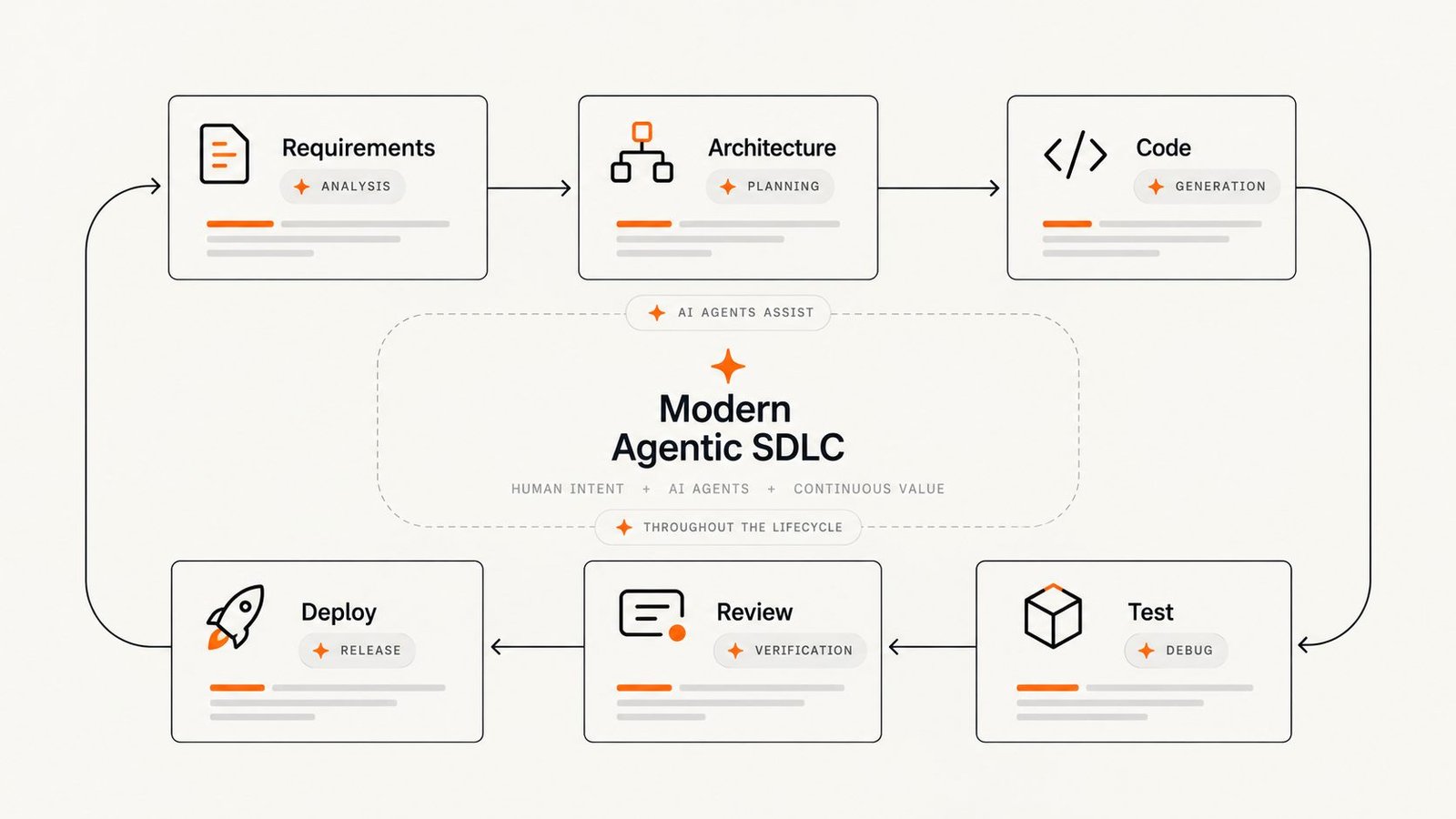
Agentic development does not mean giving an AI model a vague product idea and expecting a production application to appear automatically. Successful AI-assisted engineering still requires clear requirements, strong architecture, context, validation and human oversight.
Product requirements. Teams define business goals, user flows, functional requirements, constraints, acceptance criteria, security requirements and expected edge cases. Clear specifications become even more valuable when agents are involved.
Architecture and planning. An AI coding agent can inspect repository structure, database schemas, APIs, components, authentication flows, coding conventions, tests and dependencies, then propose an implementation plan before modifying the system.
Implementation. Agents can coordinate changes across database migrations, backend services, API endpoints, validation schemas, frontend components, application state, permissions and automated tests.
Testing and debugging. Agents can execute tests, inspect failures and attempt fixes, creating an iterative implementation-test-investigate-fix cycle.
Code review. AI can perform a first-pass review for obvious bugs, missing validation, inconsistent patterns, edge cases, security concerns and test gaps before human review begins.
The Developer's Role Is Changing
AI coding agents do not simply reduce the need for developers. They change what strong developers spend their time doing. Writing syntax becomes less important; understanding systems becomes more important.
System design. Experienced engineers still need to decide how authentication, permissions, APIs, databases, queues, caching, integrations and infrastructure should work together. Generating code is easier than designing a reliable system.
Product understanding. An agent can implement the wrong requirement extremely efficiently. Engineers therefore need to understand both the technical task and the business problem the software is solving.
Context engineering. Agents perform better when they understand architecture guidelines, coding standards, project documentation, database conventions, component patterns, testing rules and security constraints.
Verification. As code generation speeds up, validation becomes more important. Teams need automated testing, type safety, code review, security controls, observability, staging environments and disciplined release processes.
Gartner’s September 2026 guidance emphasizes building organizational context, controls and verification around coding agents. See Gartner: Build the AI Coding Harness.
AI Changes More Than Coding
The biggest gains appear when AI is integrated across the delivery workflow, not only inside the code editor.
- Product discovery: organize research, analyze requirements and surface unanswered questions.
- UX and prototyping: move from rough ideas to testable interfaces faster.
- Development: implement defined functionality across frontend and backend systems.
- Quality assurance: generate test cases, explore edge conditions and assist with debugging.
- Documentation: update technical and product documentation alongside implementation.
- DevOps: assist with infrastructure configuration, CI/CD pipelines, monitoring and deployment investigation.
Can AI Agents Build an Entire Product?
Increasingly, agents can build significant portions of a product. That is different from saying businesses no longer need experienced engineers. Production systems still require scalable architecture, secure authentication, authorization, reliable databases, integrations, observability, performance optimization, error handling, testing, deployment infrastructure, backups and sound product decisions.
AI accelerates implementation. It does not eliminate the need to design the system properly.
The Risk of “Vibe Coding” Production Software
AI has dramatically lowered the barrier to creating prototypes. That is useful for experimentation, but dangerous when prototypes are treated as production systems without proper engineering.
The goal should not be to generate as much code as possible. The goal should be to deliver reliable software faster.
- Weak authorization
- Exposed credentials
- Inefficient database queries
- Fragile architecture
- Missing validation
- Insecure APIs
- Poor error recovery
- Untested edge cases
- Scalability problems
Security Becomes Even More Important
Agentic development introduces new security considerations because coding agents may have access to source code, terminals, development environments, internal documentation, deployment tools and third-party APIs.
Gartner highlights sandboxing, environment integrity and governance as important capabilities for organizations adopting coding agents. See Gartner Market Guide for Agentic Development Sandbox Platforms.
Engineering teams should apply least-privilege access to AI agents just as they would to people and production services.
What Does This Mean for Software Development Costs?
AI can reduce the time required for many development tasks, but development cost does not disappear. Value shifts toward architecture, product strategy, senior engineering, integrations, quality assurance, infrastructure, security, monitoring and ongoing optimization.
Businesses should be skeptical of claims that complex production software can now be built almost instantly simply because AI writes code. AI improves leverage; it does not remove business complexity.
What Software Teams Will Look Like Next
Engineering teams are likely to become smaller, faster and more capable. A developer may supervise several parallel agents handling implementation, test generation, refactoring, bug investigation, documentation and code review.
Gartner’s 2026 market overview says coding agents are moving from single-threaded assistance toward orchestrated, multi-agent workflows. See Gartner: Enterprise AI Coding Agent Market.
Should Your Business Adopt Agentic Development?
For most software teams, the answer is yes—but carefully. Start with well-defined areas where AI can create immediate leverage, then expand agent access as engineering controls mature.
The strongest teams will combine AI speed with experienced human judgment.
- New feature implementation
- Repetitive CRUD development
- Automated testing
- Documentation
- Refactoring
- Debugging
- Internal tools
- Migration work
- Prototype development
The Future Is AI-Native Engineering
Software development is not disappearing. It is becoming more automated. The competitive advantage will increasingly belong to teams that combine product thinking, engineering expertise, AI agents and strong validation.
Organizations that simply add an AI coding assistant to the old development process may see incremental improvements. Organizations that redesign their engineering workflow around AI can achieve much larger gains while keeping humans focused on architecture, product logic, security and judgment.
Build Software With an AI-Native Engineering Team
At BXTrack, we design and build AI-powered products, SaaS platforms, automation systems and custom web and mobile applications. Our approach combines modern AI-assisted engineering with experienced product development—using AI where it creates meaningful speed without compromising architecture, security or product quality.
If you are planning a new SaaS platform, AI product or custom software system, talk to BXTrack about turning your idea into a production-ready product.
Sources & Further Reading
Selected authoritative references used to support the market and technology claims in this article.
- JetBrains Research: AI Coding Agents: Adoption Trends
- Gartner: Critical Capabilities for Enterprise AI Coding Agents
- Gartner: Enterprise AI Coding Agents: 2026 Market Guide & Trends
- Gartner: Market Guide for Agentic Development Sandbox Platforms
- McKinsey & Company: Beyond the copilot: Scaling the agentic product development life cycle
- Google Cloud: AI agent trends 2026 report
Written by
Arslan Chaudhary
Technical Team Lead, BXTrack
Arslan Chaudhary is Technical Team Lead at BXTrack, where he leads the engineering work that puts AI inside real SaaS products.