
Engineering
Full-Stack Development with the MERN Stack: A Practical Map
MongoDB, Express, React, and Node.js are a stack, not a finished product. Here is what each layer should own, how a request moves through them, and the work full-stack teams still have to design.
Arslan Chaudhary, Technical Team Lead, BXTrack
December 11, 2025·9 min read
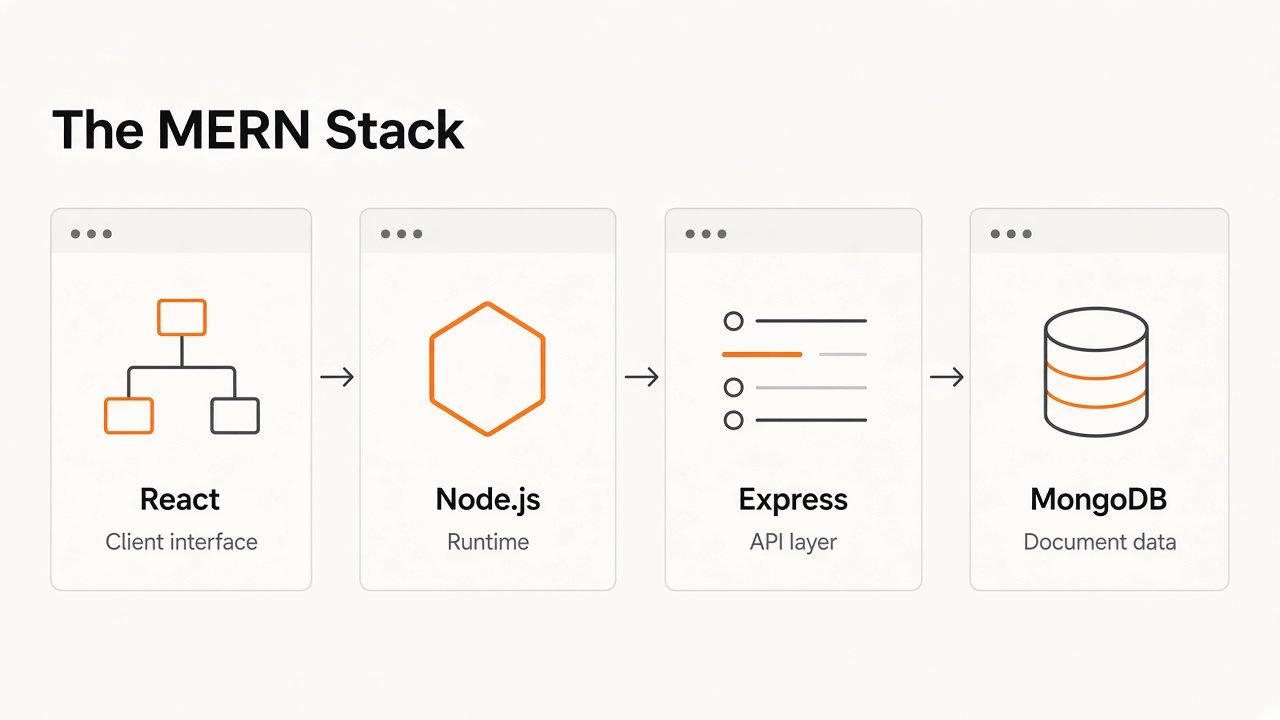
MERN is a useful default for a lot of product work. React handles the interface, Node.js runs the server, Express exposes the API, and MongoDB stores documents that look a lot like the objects the application already uses. A small team can ship a real product without inventing a new architecture for every feature.
That convenience is also the trap. A stack is a set of tools. A product is a set of decisions: who is allowed to do what, which data is authoritative, what happens when a write fails halfway, and how the interface stays honest when the server says no.
Full-stack development is the work of holding those decisions across the whole path, from the screen a person touches to the record that has to be true later.
Full stack is a set of boundaries
People use “full stack” to mean one person who can touch the interface and the server. That is a staffing description. The engineering meaning is stricter. A full-stack system has a clear owner for each step of a user action, and those owners do not quietly take on each other’s jobs.
In a MERN product the split is usually this. React proposes an action and renders the result. Express, running on Node.js, decides whether the action is allowed and what the business rule actually is. MongoDB stores the outcome. If the React app starts inventing permissions, or the database becomes the only place a rule exists, the product gets harder to change and easier to break.
What each part of MERN is for
React is the client. It owns screens, forms, local interaction, and the way data is shown. It should know how to ask for something and how to display success, failure, and loading. It should not be the place that decides a refund is allowed or that a tenant can see another tenant’s records.
Node.js is the runtime, not a separate product feature. It is the environment that runs JavaScript on the server: the HTTP process, the package ecosystem, and the place background work can live. Express sits on that runtime and gives the application its routes, middleware, and request lifecycle.
Express is the API. A route should read like a capability the product offers: create an order, invite a member, publish a draft. Middleware is where authentication, tenancy, and request logging belong, so every route does not reimplement them.
MongoDB stores documents. That fits products whose records are nested and evolve: a profile with addresses, an order with line items, a workspace with settings. The database is good at storing and querying those shapes. It is not a substitute for the rules that say which writes are legal.
One request, end to end
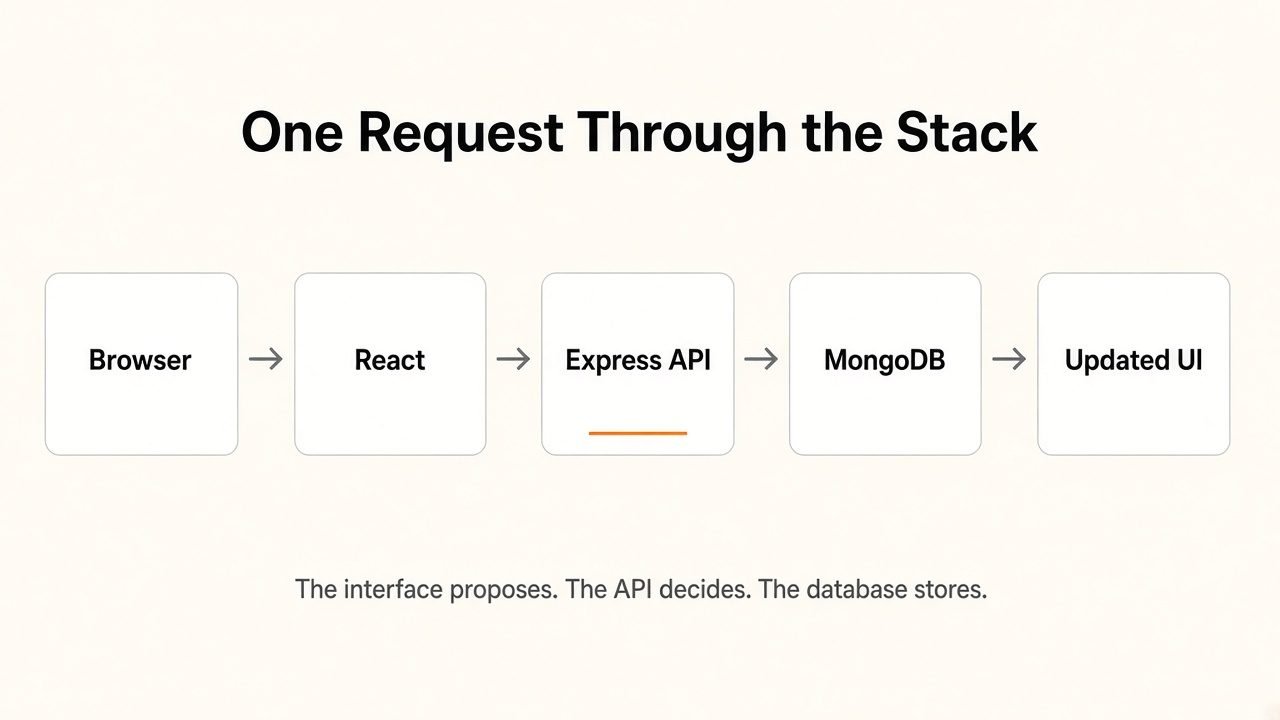
Take a concrete action: a workspace admin invites a teammate. The browser is where the person types an email and chooses a role. React checks the obvious things before the network is involved, such as an empty email or a role the screen does not offer. Then it sends one request.
Express authenticates the caller, confirms they belong to that workspace, and checks that their role may invite someone. Only then does it write the invitation. MongoDB stores the document. The response tells React what changed, and the interface updates from that response, not from what it hoped would happen.
The caption on the diagram is the rule worth keeping: the interface proposes, the API decides, the database stores. When those three jobs collapse into one layer, bugs stop being local.
Keep the API as the source of truth
React will be wrong sometimes. A stale tab, a hidden button, or a crafted request can all ask for something the user should not get. That is normal. The API has to reject it with the same rule the interface tried to follow.
Validate input on the server even when the form already validated it. Check ownership on the server even when the screen only listed the user’s own records. Return errors the client can show without guessing: not authorized, already invited, plan limit reached.
Shared types help, and a MERN codebase can share them because both sides are JavaScript or TypeScript. Sharing a type is not the same as sharing a rule. The type says an invitation has an email and a role. The API says which roles exist and who may assign them.
Model documents around how they are used
MongoDB will accept almost any shape. That freedom is useful early and expensive later if every screen invents its own document. Model around the questions the product actually asks.
If the product always loads an order with its line items, keep the line items with the order. If it always lists invoices by customer and date, make sure that query is indexed and does not require scanning every document. If two users can edit the same record, decide what “latest” means before you discover it in production.
A few habits prevent most of the pain:
- Give every tenant-owned document a workspace or account id, and include it in queries.
- Store ids for relationships you will look up, not just embedded copies that drift.
- Write indexes for the list screens you already have, not for queries you might add someday.
- Keep money, status, and permissions in fields the API updates on purpose, not in free-form blobs the client edits.
The stack does not include the product
MERN gives you an interface toolkit, a server runtime, a routing library, and a database. A product still needs the pieces those tools do not decide for you.
- Authentication and sessions, including what happens when a password changes or a member is removed.
- Authorization that is checked on every route, not only hidden in the navigation.
- Background work for email, exports, webhooks, and anything that should not block the request.
- File storage, because large uploads do not belong inside MongoDB documents.
- Logs, error tracking, and a way to tell which request produced a bad write.
- Migrations or a disciplined way to change document shape without breaking old records.
A shape that stays readable
The repository can stay simple for a long time. A client app, an API, and a small shared folder for types is enough until the product earns more structure. What matters is that a feature is findable: the screen, the route, the validation, and the data access for “invite a member” should be obvious from the name.
Put business rules in functions the route calls, not inline in the handler and not in a React component. Put database queries behind a small module so a screen never reaches into the driver directly. When a second client appears later, a mobile app or another service, it should be able to use the same API without copying rules out of the React code.
When MERN is the wrong default
MERN is a strong fit for product interfaces with evolving, document-shaped data and a team that wants one language across the stack. It is a weaker fit when the system is mostly heavy reporting across rigid relational data, when transactions span many records that must commit together, or when the team already has a deep investment in another ecosystem.
Choosing it should be a product decision, not a habit. If the core of the system is a ledger, a warehouse of analytical data, or a workload that is not request-and-response, say so early and pick the tools that match that work. The rest of the product can still use React.
At BXTrack we use this stack when it keeps a product moving without hiding the rules. The useful test is simple: a new engineer should be able to trace one important action from the button to the stored record, and explain who is allowed to run it.
Written by
Arslan Chaudhary
Technical Team Lead, BXTrack
Arslan Chaudhary is Technical Team Lead at BXTrack, where he leads the engineering work that puts AI inside real SaaS products.