
AI SaaS
AI Agents vs SaaS: What Should Businesses Build in 2026?
AI agent or traditional SaaS? Compare both approaches and learn when businesses should build SaaS, AI-powered software or an agentic product.

Muhammad Usman, CTO, BXTrack
April 2, 2026·11 min read
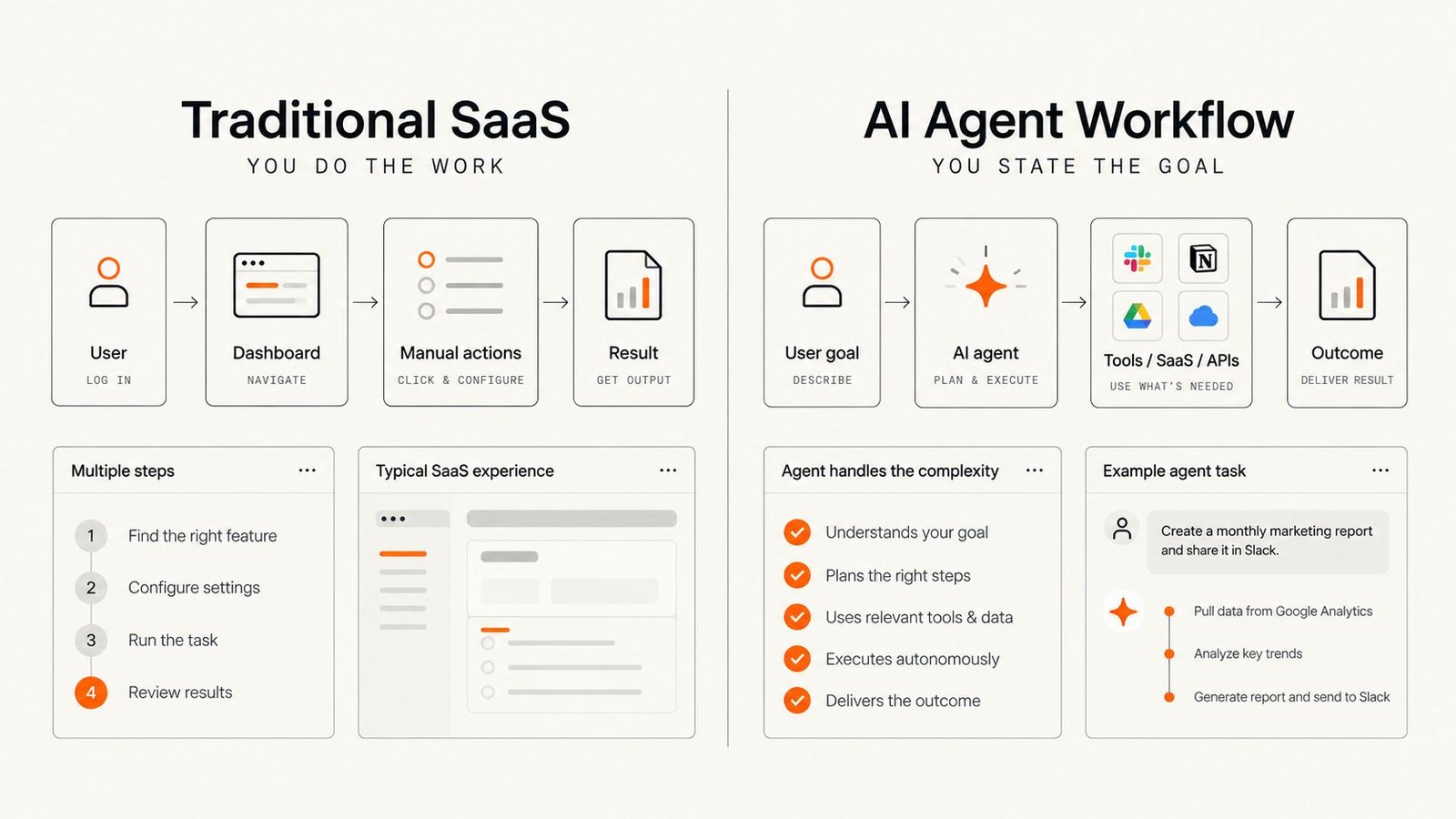
For more than a decade, the default answer to almost every business software problem was simple: build or buy a SaaS application. Need to manage customers? Use a CRM. Need to manage projects? Use project-management software. Need to schedule employees? Use workforce-management software. Need reports? Add another dashboard.
That model is starting to change. AI agents are changing software from something users operate step by step into something that can increasingly execute work on their behalf.
Businesses considering a new software product now face a more interesting question: should we build traditional SaaS, AI-powered SaaS or an AI agent? The answer is rarely one or the other.
What Is Traditional SaaS?
Software as a Service is software accessed over the internet, typically through a browser or mobile application. Common examples include CRMs, accounting platforms, project-management systems, scheduling software, HR platforms, analytics products and help desks.
The normal interaction model is: User → Interface → Feature → Action → Result. The application provides the tools, but the user performs and coordinates the workflow.
What Is an AI Agent?
An AI agent works differently. Instead of exposing only features, an agent can be given a goal. It can reason about that goal, decide what actions are needed and interact with tools or systems to complete those actions.
For example: “Review all qualified leads that have not received a response in the last five days, prioritize the strongest opportunities, draft personalized follow-ups and create tasks for anything that requires my attention.”
The interaction becomes: User → Goal → Agent → Systems → Outcome. Google Cloud describes this 2026 shift as moving from one-off prompts toward systems that orchestrate complex, end-to-end workflows semi-autonomously. See Google Cloud AI Agent Trends 2026.
- Query the CRM
- Inspect each lead
- Check communication history
- Prioritize opportunities
- Generate personalized messages
- Create follow-up tasks
- Return a summary
- Ask for approval where necessary
AI Agents vs SaaS: The Core Difference
Traditional SaaS primarily provides tools for users to operate. AI agents increasingly provide work that software performs on the user’s behalf.
In a traditional SaaS example, a manager views appointments, checks employee availability, assigns technicians, opens a map, optimizes routes, sends updates and reschedules conflicts.
In an agentic system, the manager says: “Optimize tomorrow’s schedule. Prioritize urgent customers, keep technicians within their service areas and minimize travel time. Ask me before moving VIP appointments.” The agent uses the underlying systems to create the schedule.
The software has not disappeared. The interaction layer has changed.
Does That Mean SaaS Is Dying?
No. SaaS remains essential because agents still need structured data, business rules, authentication, APIs, permissions, workflows, databases and integrations. In many cases, the SaaS platform becomes the infrastructure underneath the agent.
Gartner estimates that up to $234 billion of enterprise application software spending could be exposed to “agentic arbitrage” by 2030 as agents complete tasks across multiple systems and reduce the need for direct interaction with every application interface. See Gartner’s July 2026 analysis.
The implication is not that business software disappears. It is that software increasingly becomes something agents operate as well as humans.
The Evolution: Traditional SaaS to Agentic Products
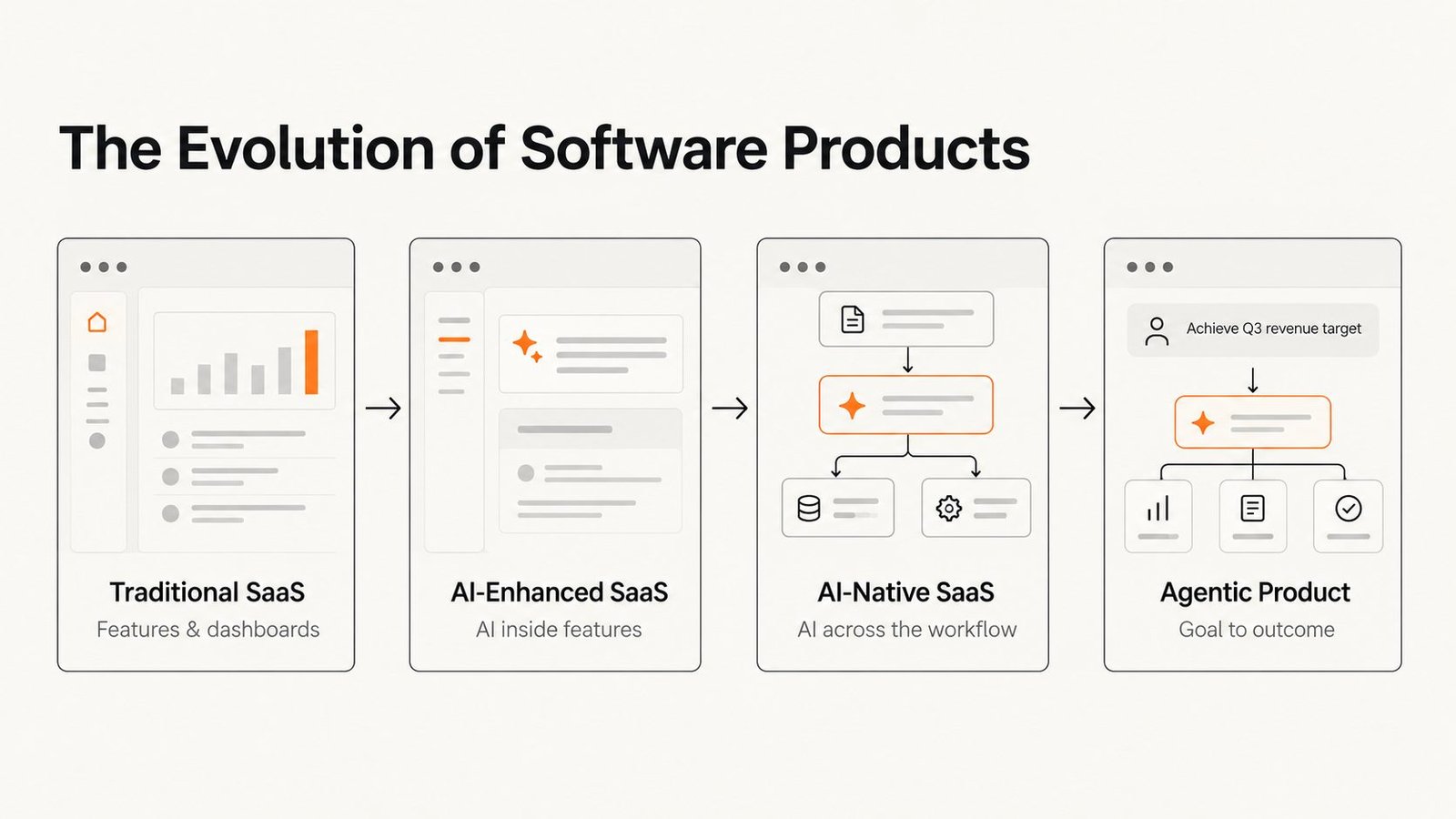
Stage 1: Traditional SaaS. The application contains workflows and features. The user operates everything: create an invoice, change an opportunity stage, schedule an employee or export a report.
Stage 2: SaaS With AI Features. The application remains mostly traditional but adds features such as text generation, summarization, classification, prediction or recommendations.
Stage 3: AI-Native SaaS. AI becomes central to the product experience. Intelligence is built across the workflow and the system can use context proactively.
Stage 4: Agentic Software. Users specify outcomes. Agents determine how to achieve those outcomes using the product’s tools, data and integrations. Dashboards become places for visibility, control and exceptions rather than the place where every individual task must be performed.
When Should You Build Traditional SaaS?
Traditional SaaS remains the right model when users need predictable, structured workflows and explicit control over data and actions.
- Financial management
- Inventory management
- Payroll
- Point of sale
- Regulatory workflows
- Administrative systems
- Dashboards
- Highly structured operational tools
When Should You Build an AI Agent?
An AI agent becomes particularly useful when work involves interpreting information, making decisions within defined rules, coordinating multiple systems, repetitive knowledge work, unstructured data, multi-step workflows or frequent context switching.
Microsoft similarly describes agentic AI as a move from systems that respond to requests toward systems that participate in executing work across tools and processes. See Microsoft: Agentic AI for Business Workflows.
- Sales agents: research prospects, qualify leads, update CRM records, draft outreach, summarize conversations and schedule follow-ups.
- Customer support agents: understand requests, search documentation, inspect customer history, create tickets, recommend solutions and escalate complex cases.
- Operations agents: monitor workflows, identify exceptions, coordinate tasks, prepare reports and notify relevant teams.
- Finance agents: invoice matching, reconciliation support, anomaly detection, document processing and reporting.
The Best Product Is Often Both
The most important takeaway from the AI agents vs SaaS debate is that businesses often should not choose one. A strong product can combine a structured SaaS foundation with an agentic layer.
Imagine a CRM that still contains contacts, companies, opportunities, activities, permissions, pipelines and reporting, but also includes an agent that can identify quiet opportunities, prepare follow-ups, send approved messages and create reminders.
This is more powerful than either a conventional CRM or a standalone chatbot. It is SaaS infrastructure combined with agentic execution.
AI-Native SaaS Is More Than Adding a Chatbot
A common product mistake is adding a chat window to an existing application and calling it AI-native. A real AI-native product is designed around what AI changes.
McKinsey’s 2026 research supports this systems view, arguing that leading teams redesign operating models, roles, verification and AI operations rather than simply deploying AI tools. See McKinsey: Beyond the copilot.
- Context. The agent needs access to the right information.
- Tools. The agent needs controlled actions it can perform.
- Permissions. The system must define exactly what the agent can access and change.
- Memory. The product may need to preserve relevant context across interactions.
- Observability. Users and administrators should understand what the agent did.
- Approval flows. High-impact actions may require human approval.
- Evaluation. Teams need ways to measure whether the agent consistently completes tasks correctly.
- Fallbacks. The product needs predictable behavior when the AI cannot confidently complete a task.
What Should Your Product’s Interface Look Like?
AI does not mean every interface should become a blank chat box. Tables remain good for comparing records. Charts are useful for trends. Forms are useful for precise structured input. Calendars are useful for time. Maps are useful for location. Visual canvases are useful for design.
The strongest AI-native products combine these interfaces with conversational or agentic interaction. The interface becomes a place for visibility, control, review and exception handling while the agent handles more of the workflow.
How to Decide What Your Business Should Build
Is the workflow predictable? If the same steps happen every time, conventional automation or SaaS may be enough. If the workflow requires interpretation and decisions, an agent becomes more useful.
Is the input structured? Structured database records are straightforward for conventional applications. Emails, documents, conversations and mixed information create stronger opportunities for AI.
Does the work span multiple systems? The more applications a person must switch between, the more valuable an agent can become.
How risky are incorrect actions? An agent recommending an action and an agent transferring money are very different risk profiles. High-impact actions need stronger verification, permissions and approvals.
Does the user need an interface or an outcome? Sometimes users genuinely need to explore software manually. Other times they simply want the work completed. This distinction is one of the most important product decisions in the AI era.
Build vs Buy Still Matters
Not every business needs to build its own AI agent. Buying is usually sensible when the workflow is standard, existing products solve it well, differentiation is low and integration requirements are simple.
Custom development becomes more attractive when the workflow is unique, software is core to the business, existing tools require excessive manual work, several disconnected systems need coordination, proprietary data creates an advantage or the product itself will generate revenue.
What Should Startups Build in 2026?
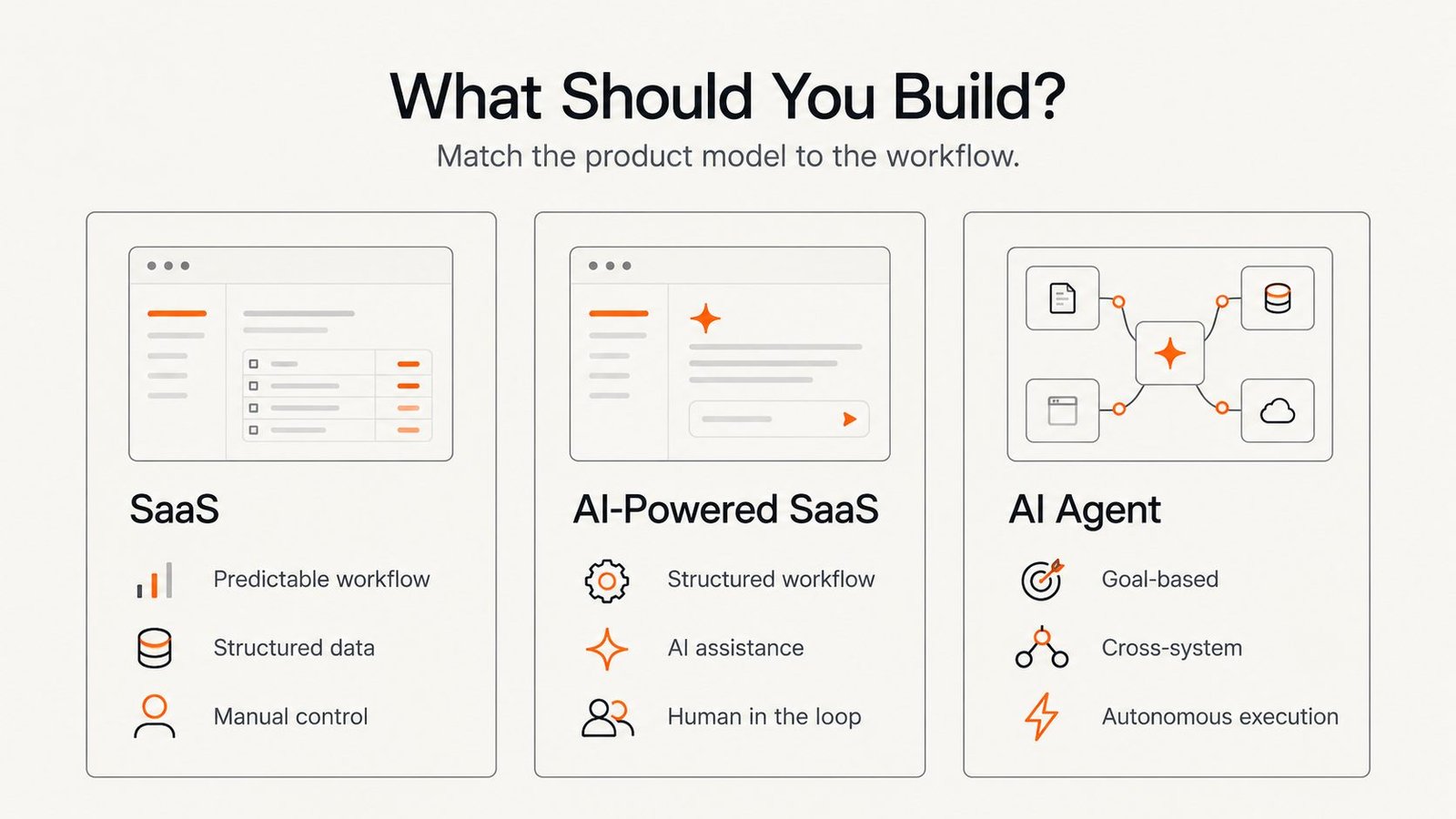
Many startups should stop beginning with the question “What dashboard should we build?” and start with “What outcome is our user trying to achieve?” Then determine how much of that outcome software can perform automatically.
A strong AI-native product can combine a structured SaaS foundation, AI reasoning, tools and integrations, agentic workflows, human approval and a traditional UI where it is useful.
AI Agents Are Changing SaaS Economics Too
Traditional SaaS businesses frequently charge per user or seat. That model makes sense when every employee directly uses the application. Agentic software complicates that assumption because agents can increasingly perform work across multiple systems on behalf of users.
Gartner argues that agentic AI can weaken the traditional link between SaaS seat growth and customer value, increasing pressure toward outcome- and usage-oriented models. See Gartner: Agentic Arbitrage and SaaS.
So: AI agent or SaaS? Choose traditional SaaS when users need structured tools and predictable interaction. Choose an AI agent when the primary value comes from reasoning, interpretation and controlled autonomous execution. Choose AI-powered SaaS when an existing workflow benefits from intelligence but still requires substantial direct user interaction. Choose an AI-native agentic product when users care more about accomplishing a goal than manually operating software.
The future is unlikely to be SaaS or AI agents. It is increasingly SaaS infrastructure, AI intelligence and agentic execution.
- Usage
- Transactions
- Tasks completed
- Workflows executed
- Compute consumption
- Business outcomes
Build for the Way Software Is Changing
Businesses building products today have an opportunity to rethink how much work the software itself should perform. The companies that benefit most from AI will not simply add an AI button to an existing product. They will redesign workflows around what becomes possible when software can understand context, make decisions and take controlled actions.
Building an AI Product or SaaS Platform?
BXTrack builds AI agents, workflow automation, AI-powered SaaS platforms and custom software products. We help companies move from product idea and architecture through design, development, integrations and production deployment.
Whether you need a conventional SaaS platform, an AI-powered workflow or a fully agentic product, the right architecture starts with understanding the business outcome.
Sources & Further Reading
Selected authoritative references used to support the market and technology claims in this article.
- Gartner: Gartner Says $234 Billion in Enterprise Application Software Spend Is at Risk from Agentic AI
- Gartner: Agentic Arbitrage Is Making Enterprise SaaS Headless
- Gartner: The Future of Enterprise Applications
- Google Cloud: AI agent trends 2026 report
- Microsoft: From responding to executing: How agentic AI is becoming part of the workflow
- McKinsey & Company: Beyond the copilot: Scaling the agentic product development life cycle
Written by
Muhammad Usman
CTO, BXTrack
Muhammad Usman is CTO at BXTrack. He helps companies decide what to build — traditional SaaS, AI-powered software, or agentic products — and turn that decision into systems that scale with the business.